



 | |
 | |
(Reprint with premission from CRM Forum).
This week, we?re pleased to publish the results of the analysis of a survey the CRM-Forum undertook last year in conjunction with the CRM Institute of the University of Strathclyde and Caledonia Business School. The report is called ?Improve the ROI of CRM : A Report of the Factors Impacting on the Success and Failure of CRM Projects.? If you are trying to understand how to achieve ROI from your CRM programmes it should provide valuable input from other companies? experiences in aggregate form.
The report was based on a survey of CRM-Forum members last year, with over 700 responders. It examines the factors which impact the success of CRM projects from the perspectives of companies implementing CRM, consultants supporting those projects, and companies supplying software products and other products and services to the CRM industry. We covered some of the findings from that survey in an earlier editorial, but the full report includes more sophisticated analyses undertaken by the CRM-Institute.
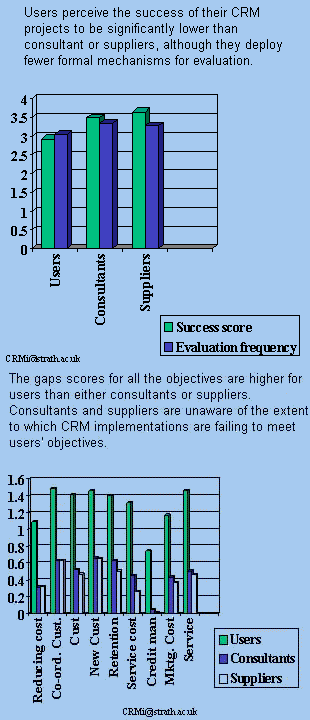
This first slide (top graph) shows that companies think their CRM projects are significantly less successful than either consultants or suppliers. The interesting question is, of course, who is right? One might expect suppliers to have a more bullish view of success than the companies implementing their products, but one would hope that consultants would have a sufficiently objective view that their view of success would tie up with their clients. The very fact that there is a significant difference suggests that the consultants and the companies they advise are not working together in total sync. Given the widespread view of the high failure rate of CRM projects, one suspects that the companies have a more realistic view of the project success rate than their consultants. This in itself is a little disturbing.
The graph above shows the gap between the perceived importance of an objective for a CRM project and the success in achieving that objective. The first and perhaps most important point is that there is a significant gap in all cases between the importance of the objective and the success in achieving it. This confirms that companies are having difficulty in meeting their objectives, and hence (probably) delivering ROI. What is even more striking is the difference in the views of staff working for companies implementing CRM compared with the consultants supporting them. With one objective excepted, the users think the gap between importance and success is well over 1 in a five-point scale, whereas consultants see the gap as roughly .5 on the same scale. Assuming that the companies implementing CRM have the more realistic view this seems to imply that consultants are seriously under-estimating the lack of success of their CRM projects.
We find this rather disturbing and it has to raise the question as to whether the consultancy companies, and particularly the Big 5, are successfully supporting their clients in the implementation of CRM programmes. At its worst, one has to wonder whether or not they are part of the problem.
Of course the gap is usually even wider when one considers the suppliers? understanding of success, but to a certain extent this is less worrying. We know that the supplier of a software product has a vested interest in the success of the use of his product and we accordingly adopt an attitude of ?caveat emptor? in our dealings with them.
However, the word consultant implies a certain level of independent, considered, and expert advice, at least to me. The disconnect between consultants? views and the companies they are supporting leads one to wonder whether the consultancies are offering such independent expert advice to their clients in the CRM space. Let?s explore that in more detail.
There was recently an interesting debate on this very question which pointed out that nearly all Big 5 consultancies have strong links with one or two of the major suppliers of CRM software packages. Of course they need expertise in the products they help to implement at client sites, but these links raise the question as to whether they can offer independent advice on the selection of such products, or even the appropriateness of the product in achieving the objectives of the programme and hence ROI. Many of the Big 5 consultancies have strategic relationships with Siebel which, at one time was almost synonymous with CRM, and it is interesting that it appears almost impossible to get a clear statement from Siebel of the likely ROI from a Siebel implementation. We have explored this difficulty in a previous editorial
If their independence is suspect, perhaps we should also question their level of expertise in the delivery of benefit of CRM. Here one has some sympathy with their difficulties. The huge interest in CRM around the year 2000 led to an explosion of major CRM projects around the globe. Although I am sure all the Big 5 consultancies have expert CRM practitioners, there was already a shortage of that expertise, and the explosive growth of CRM projects almost certainly led to that expertise being over-stretched. However, if a particular consultancy?s experts were over-stretched, this does not excuse the consultancy taking on projects if they were unable to deliver the expertise required to deliver the benefits from the project.
If the Big 5 don?t offer independent advice, and they don?t have sufficient CRM practitioner expertise, why do companies choose to use them so frequently? It seems to me their core competencies revolve around being able to provide project resources for large-scale IT implementation projects and the ability to manage those projects. This has undoubted value to major corporates, but in the case of CRM programmes has additional downsides. Firstly, for almost as long as the CRM-Forum has been going, we have been recommending small-scale, iterative implementations of CRM programmes, and at least lip-service is frequently paid to that recommendation by the industry. However, if your advisor?s business model supports large-scale projects it seems likely that they may propose a large-scale project, with an inherent increased risk of failure, at least in the CRM space.
Secondly, the focus on IT capability may also not be helpful. It is becoming a truism that CRM requires a business strategy to deliver the benefits from the enabling CRM technology. Are organisations focused on large-scale IT implementations best equipped to develop that business strategy and ensure the benefits are delivered? The poor results from many CRM projects seem to suggest that they do not. Interestingly enough, as long ago as September 2000 I wrote an editorial expressing surprise that the heads of the Swiss offices of PwC and KPMG at the CRM-Connect conference claimed that up to 66% of CRM projects would fail and that it was all the fault of the companies implementing CRM. I have always felt that if you are offering independent expert advice to a project it becomes very difficult to avoid some level responsibility for the success of the project if you continue to support it through to implementation.
So what does this mean for the responsibility for the big 5 consultancies for the current failures of CRM programmes? It seems to me that, at the very best their use of the word ?consultancy? provides confusing branding to the marketplace. They offer undoubted expertise in delivering complex IT projects, but their ability to offer independent expert advice should be tested with the same ?caveat emptor? approach that companies would use when purchasing a software product from a software vendor.
Companies undertaking major CRM programmes, might well find it valuable to take a leaf out of the oil industry?s approach when building offshore oil platforms. Oil companies do appoint an ?implementation contractor? to take responsibility for the building and hook-up of the oil platform, equivalent to the role the Big 5 play in building and system integration of major IT environments. However, the oil companies also appoint independent ?project engineers? to monitor the development of the project, to keep the project vision alive, and ensure the earliest possible delivery of oil (ROI) from the platform. Those project engineers do not come from the implementation contractor. Independent CRM practitioners with experience of delivering the business benefits from CRM, and sufficient understanding of IT to monitor the detailed technical implementation could play a similar role in CRM programmes.