|
QueWeb Customer Care Suite
 Benefits Benefits
Features
Key Differentiators
Requirements
CRM Upgrade
Avaya
AIC Bus. Apps
Siebel
CRM
Peoplesoft
CRM
Vantive
Process
Demo
|
|
|

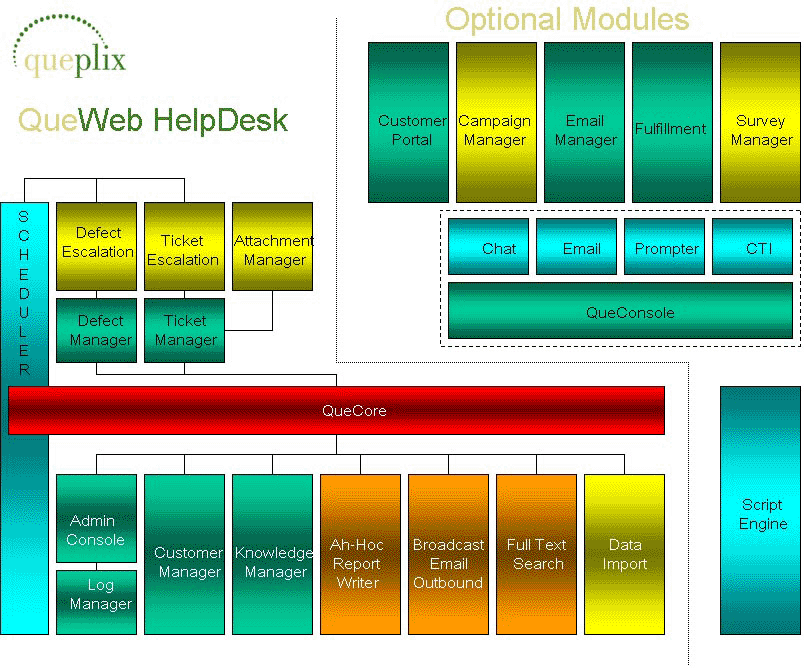
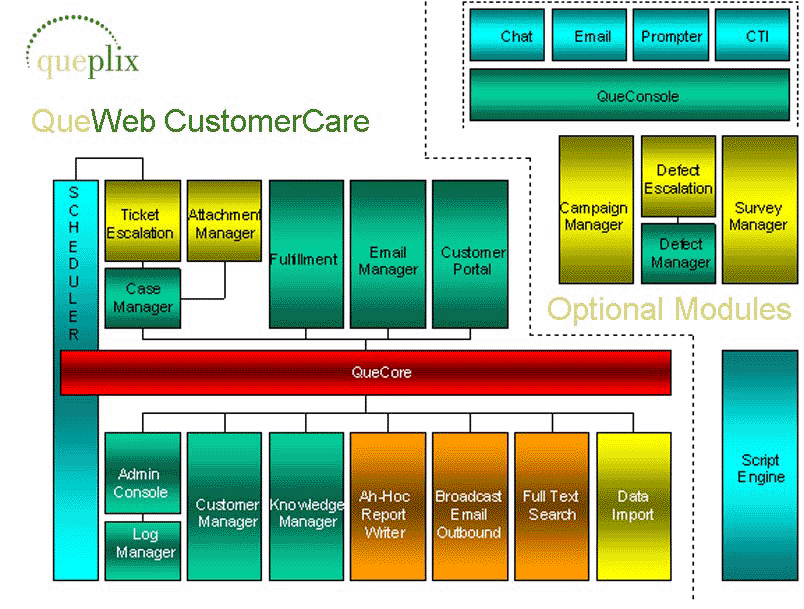
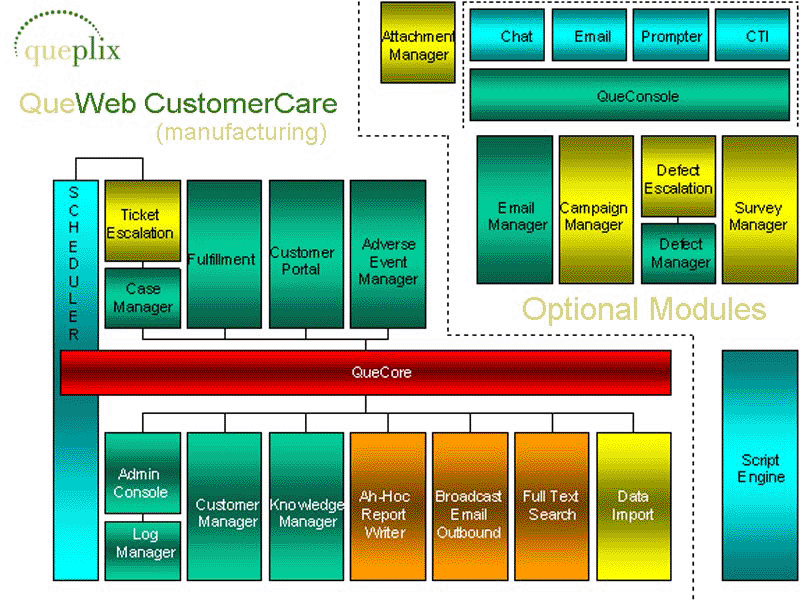
Three out-of-the-box versions of QueWeb are available:
These variations are structured around a �Foundation Set� (QueFoundation) that
includes QueWeb�s proprietary core. Module sets are then assembled around the
Foundation to provide more specific functionality. By adding other optional and
custom developed modules, the nature of the application can easily be evolved to
the exact needs of each customer.
Block diagrams of these variations should be found by clicking on the
appropriate html link above.
QueWeb is strictly compliant with J2EE standards and its system architecture
leverages the strengths of the newest Java technologies. This architecture
approach has resulted in a clear separation of presentation from content data,
while providing enhanced performance for the web interface. Data is transformed
and stored as XML in QueWeb�s database.
It is well known that the majority of today�s enterprise and mid-market software
projects involve a significant amount of integration. Some researchers have
suggested that in highly complex B2C, or more complex B2B projects, integration
work, especially in the areas of process and content integration, may represent
as much as 75% of the total project cost.
For a variety of reasons, Java represents an ideal language for application
integration.1 First, it runs on most (if not all) operating systems and is well
supported by EAI tool vendors. Second, J2EE provides the security, messaging,
and reliability services required in EAI.
Two very different integration architectures have seen wide deployment;
 |
direct point-to-point connectivity; and
|
|
|
middleware-based integration. |
Historically, EAI developers implemented point-to-point integration because it
was the most direct route to a solution�easy to understand and well suited to
situations when there are just a few systems to integrate. With this approach,
the application makes direct JDBC (Java Database Connection) calls to another
application's database tables. However, this style of implementation does not
scale well. Thus, while three applications only need three connections
(integration points), four applications need six and five applications require
ten.
Middleware-based integration has become the preferred choice because it
overcomes this connection-scaling problem. Middleware provides generic
interfaces with which all integrated applications pass messages to each other.
Thus, if an organization has five applications to integrate, it only requires
five integration points. Middleware-based solutions easily support numerous
integrated applications and require less maintenance.
Java provides EAI developers with three flexible architectural options; message
bus, centralized, and JCA-based. Further, it facilitates integration at several
different levels; user-interface (UI) level, application level, method level and
the data level.
QueWeb has been architected to fully exploit all of these integration options.
Built atop J2EE technology, QueWeb provides essential core capabilities
leveraged by the individual functional components, or modules, that comprise the
system. These existing modules are assembled by Queplix� professional services
group in order to create complete applications for customers. Modules can be
configured and customized in order to tailor the resulting application to meet
the customer�s exact requirements. This includes both functional (business
rules) and visual (GUI) changes.
In this way, QueWeb�s core technology provides a foundation for customization
while maintaining important separation between database, business logic and
graphical components. This architecture helps ensure that customization is
straightforward.
100% configurable. 100% customizable. With QueWeb, you�re able to work the way
you want to work, and deploy eService, help desk and call center applications in
half the time, and at half the cost of typical CRM software. |
|

 Home
Home